The subject is up for much discussion: SEO-friendly URLs. Should or shouldn’t I include the category? Should the URL be as short as possible or is there room for extras? Could an URL be stuffed with keywords or not?
In this post, I’ll explain our take on SEO-friendly URLs and try to elaborate a bit on why we think that is the best option for that link. First, let me tell you that a SEO-friendly URL differs per type of website. In this article, I’ll discuss a few to show the differences. There are a few ground rules, but I strongly encourage you to keep the visitor in mind when setting up your URL structure or picking a slug.
Ground rules for SEO-friendly URLs
No matter what kind of website you have, there are a couple of ground rules that apply to all websites.
- The main thing to keep in mind is that your URLs should be focused. Strip your URLs of function words like ‘a’, ‘of’, ‘the’ etc. In 99% of the cases, these words add nothing of value to your URL. If possible, strip your URLs of verbs as well. Words like ‘are’ or ‘have’ are not needed in your URL to make clear what the page is about.
- The length of your URL isn’t really a factor in this. We do recommend to keep your URLs as short as possible. It’s not that Google doesn’t like lengthy URLs, but shorter URLs are most probably more focused. Keep in mind that if you use breadcrumbs on your site, as we do, these could appear instead of the full URL:
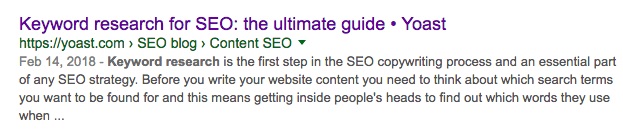
- Length isn’t that much of an issue: Google will show what they think is important for that visitor. Keep in mind that meta titles and descriptions are cut off at 512 pixels, and so is your URL.
- Don’t use underscores, as these connect the words and make them into one. Dashes are preferred.
These are the ground rules for SEO-friendly URLs. The best SEO-friendly URL differs per type of website. Pick your type of site to jump to the information that applies to your website:
SEO-friendly URLs for your company website
If your website holds information about your company and/or services and that is basically it, no matter how many pages you have, I’d go with the shortest URL possible.
http://example.com/contact/http://example.com/about-us/SEO-friendly URLs for your online shop
If your website is an online shop, there are two ways to go about:
http://example.com/product-name/http://example.com/category-name/product-name/
Some content management systems (like Magento) create both. In that case, use rel=”canonical” to point Google to the one you want to appear in Google.
The question remains what URL structure to use. In this case, SEO-friendly URLs should also be helpful URLs for your visitor. If your shop contains categories that make your visitor’s life easier, by all means, include these categories in your URL as well. That way your URL, breadcrumbs, and menu will remind the visitor where they are on your website:
http://example.com/birds/cranehttp://example.com/equipment/crane
See what I mean? Decide for yourself if your categories add that value to the product and URL. If so, it’s also better for SEO to include the category, as category and product are very much related.
SEO-friendly URLs for your blog or news site
If your website is a blog or news website, there are a number of ways to construct your URL. Let’s go over these separately:
http://example.com/post-title/
If your site as a whole has a strong coherence, you could consider focusing on the post title and the post title only to create an SEO-friendly URL. The coherence will indicate the main topic of your website to Google, so no need to add that in the URL.http://example.com/category-name/post-title/
In case that your website is a news website and you’re writing about different topics, adding the topic (for instance as a category name), will make even more clear what the page is about. It’s a bit similar as explained above at SEO-friendly URLs for your online shop.http://example.com/mm/dd/yyyy/post-title/
If your website features daily news and the news is related to a date, be sure to include that date in the URL as well. If someone is looking for the latest news on Apple’s products, the date in the URL will already show if the page is about this year’s iPhone or not. My recommendation: only use the date in the URL if the date matters.
TL;DR
There is no one way to create the best SEO-friendly URL. It depends on the type of website you have. Especially with a blog or news site, there are multiple options. The main thing is to keep your URLs focused. Besides that, make sure to include all the information that’s important to make clear what the page is about.



